We are ISO certified
Cold Storage Company

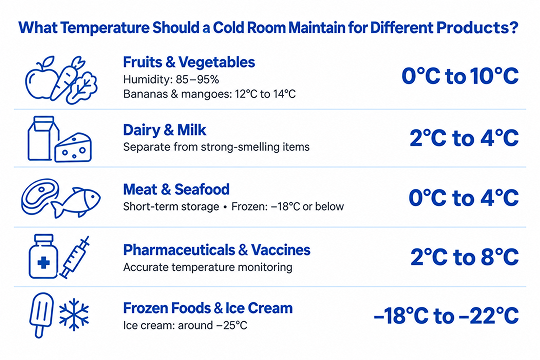
Most fruits and vegetables store well between 0°C and 10°C, with humidity of about 85% to 95%. Bananas and mangoes prefer warmer settings, around 12°C to 14°C, while apples and leafy greens like it colder.
Milk and most dairy products should be kept at 2°C to 4°C. Experienced cold room manufacturers in India often set up separate zones so dairy does not share space with strong-smelling items.
Fresh meat and seafood stay safe at 0°C to 4°C for short periods. For long storage, keep them frozen at -18°C or below.
Vaccines and many medicines need 2°C to 8°C, along with accurate temperature monitoring.
Frozen foods need -18°C to -22°C. Ice cream is usually stored colder, around -25°C, to protect its texture.
Prices depend on size, temperature, and panel type. A small cold room is the most affordable and suits shops, clinics, and small traders. A medium cold room costs more and suits dairies, seed units, and food processors.
A large cold room needs the highest investment and suits aggregators and exporters. Freezer rooms usually cost more than chillers of the same size.
Room size, set temperature, panel thickness, compressor brand, door type, and site location all change the price. Choosing among cold room manufacturers in India on price alone often leads to higher power bills later.
Running costs depend on insulation quality, how often doors are opened, and compressor efficiency. A well-built room needs only routine care, such as coil cleaning and gas checks.
PUF panels insulate well and cost less, so they are the most common choice. PIR panels offer better fire resistance and slightly better thermal performance, but they cost more.
Chiller rooms commonly use 60 mm to 80 mm panels, while freezer rooms need 100 mm to 150 mm. Most cold room manufacturers in India suggest thicker panels for freezers, since they cut electricity use over time.
Good panels with tight joints keep cold air in, so the compressor runs less. The best cold room manufacturers in India also use proper joint locks and door gaskets to stop leaks.
Always ask for panel density and thickness in writing. A trustworthy cold room supplier will share these details without hesitation.
The National Horticulture Board (NHB) offers a credit-linked, back-ended capital subsidy for cold storage projects. The assistance will be as a credit-linked back-ended subsidy at 40% of the capital cost of the project in general areas and 55% in the case of Hilly & Scheduled Areas for a maximum storage capacity of 5000 MT per project. New cold storage assistance is generally for multi-chamber, energy-efficient units.
The Mission for Integrated Development of Horticulture (MIDH) also supports horticulture infrastructure, including pre-cooling units and cold rooms. State horticulture departments process many applications. Rules and rates change, so confirm current terms on official NHB and state websites before applying.
Farmers, FPOs, cooperatives, companies, partnership firms, and entrepreneurs are generally eligible. The subsidy is credit-linked, so a bank loan is usually needed.
You will typically need ID and address proof, land documents, a detailed project report, a bank loan sanction letter, equipment quotations, and business registration papers. The usual steps are
Many cold room manufacturers in India can help with the technical details of the project report.
If you are comparing cold room manufacturers in India, Blue Ice India is a name worth shortlisting. The company designs and builds cold rooms and cold storage facilities for businesses across Gujarat.
Blue Ice India has completed cold storage installations across Gujarat for sectors like seeds and frozen foods. This on-ground experience helps the team spot layout, airflow, and power-load issues early.
Every business stores different products, so Blue Ice India plans each room around the product, temperature, and daily volume.
Blue Ice India uses quality PUF panels and energy-efficient refrigeration systems to keep running costs low. Buyers searching for the best cold room manufacturers in India usually want exactly this: strong insulation, reliable compressors, and honest pricing.
From site survey and design to installation and maintenance, one team handles everything. That makes Blue Ice India a dependable cold room supplier and cold storage room manufacturer in India for businesses that want a single point of contact.
The right cold room depends on your product, temperature, budget, and long-term running cost. Compare panels, refrigeration, and after-sales support, and check subsidy eligibility early.
Among all cold room manufacturers in India, choose a partner that explains clearly, quotes transparently, and stays with you after installation. A reliable cold room supplier will always put these things in writing.