We are ISO certified
Cold Storage Company
We are ISO certified
Cold Storage Company
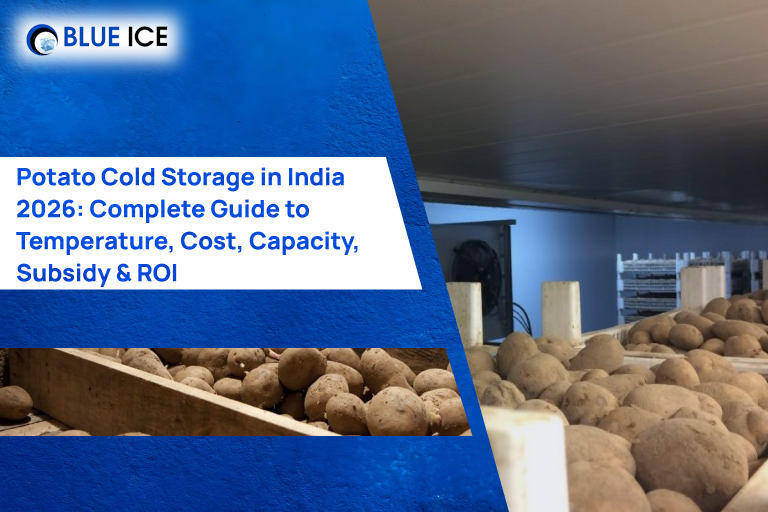
Potato cold storage in India helps farmers and traders keep potatoes fresh for many months after harvest. Without it, potatoes sprout, shrink, and rot within weeks in the heat.
India is the second-largest potato producer in the world, and most of the crop comes out of the ground between January and March. Storage lets growers sell when prices are good. This guide explains temperature, cost, capacity, subsidy, and returns in simple words.
Potatoes are living tubers. After harvest, they keep breathing and losing water every day. In normal heat, they soften and sprout fast.
Cold storage slows all this down. It cuts weight loss, stops early sprouting, and lowers rot. It also protects the color and taste that buyers want.
This means better prices for farmers and a steady supply for traders and chip makers.
Getting the potato cold storage temperature right is the most important part of storing potatoes. The ideal setting depends on how the potatoes will be used.
Table potatoes are usually kept at 2°C to 4°C in Indian stores. This keeps them firm for many months. They can turn slightly sweet, so a few days of warming before sale helps.
Seed potatoes also need 2°C to 4°C. This keeps them healthy and ready to sprout when planted. Always store seed lots separately from table potatoes.
Potatoes for chips and fries are stored at 10°C to 12°C. At this level, sugar stays low, so chips fry to a light golden color and not dark brown.
Humidity should stay between 85% and 95%. Dry air makes potatoes shrink, and very wet air causes rot. Fresh air ventilation removes extra heat and carbon dioxide, while steady air flow keeps every stack at the same temperature.
In our work on cold storage projects across Gujarat, we have seen that most spoilage comes from uneven air flow, not from the machines. That is why we always check the potato cold storage temperature at different heights and corners of a chamber, not at just one spot.
Potato cold storage in India needs a big upfront investment. The final amount depends on location, design, and equipment.
The construction cost of a cold storage plant mainly depends on its capacity. A 1,000 MT plant needs less land, fewer panels, and a smaller refrigeration system. A 3,000 MT or 5,000 MT plant needs more of everything, so the total investment is higher.
Bigger plants usually cost less per tonne because the building, power connection, and control systems are shared across more storage space.
Exact costs change with the location, design, and equipment you choose. That is why it is best to ask for a detailed quote based on your capacity and site before you decide.
Capacity, PUF panel thickness, refrigeration brand, automation, and land preparation all change the cost. Cheap materials save money today but raise power bills and repairs later.
Electricity is usually the biggest running cost. Labour for loading, repairs, and insurance add to it. Keep aside about 2% to 3% of the project cost every year for maintenance. A well-designed potato cold storage plant spends far less on power over its life.
Our engineers always advise visiting the site before finalizing any potato cold storage in India plan. Soil strength, power supply, and water availability shape the design more than most owners expect.
Choose capacity based on the potato crop in your area and the number of farmers who will use the plant. Plants of 3,000 to 5,000 MT are popular because they balance cost and income. Also, leave some room to expand later.
PUF (polyurethane foam) panels block outside heat. Panels of 100 mm or more are common for potato chambers. Tight joints and good panels keep the temperature steady and bills low.
Use reliable compressors, evaporators with proper air flow, and a standby unit. Automatic controls with alarms let you watch temperature, humidity, and carbon dioxide from your phone.
Plan wide driveways, a loading dock, a sorting area, and a power backup room. A good layout reduces handling time and potato damage.
Government support can cut your investment by a large amount.
The National Horticulture Board (NHB) and the Mission for Integrated Development of Horticulture (MIDH) support cold storage projects through a credit-linked, back-ended subsidy. It is usually 40% of the capital cost for the general areas and 55% in the case of Hilly & Scheduled Areas for a maximum storage capacity of 5000 MT per project.
The subsidy for potato cold storage in India is released after the bank loan is taken and the project is complete. Rules and cost limits change, so check the latest guidelines on the NHB website.
Farmers, farmer groups, cooperatives, companies, and entrepreneurs can apply. You usually need:
Yes, potato cold storage in India can be a steady business when planned well. Most income comes from rent charged per bag.
ROI is your yearly net profit divided by total investment, multiplied by 100. For example, if you invest ₹4 crore and earn ₹60 lakh net each year, your ROI is 15%. The payback period is about 6.7 years. A subsidy can shorten it.
Income comes from storage rent, handling charges, and renting space to other crops in the off-season. Expenses include electricity, labour, maintenance, loan interest, and insurance.
Occupancy matters most. A plant that is 90% full earns far more than one that is 60% full. Local potato output, rent rates, and power tariffs also play a role. Most plants repay the investment in about 5 to 8 years.
From our experience, owners who speak to local farmers and secure storage bookings before construction see fuller chambers from the first season. That is how a potato cold storage business turns steady.
Blue Ice India is a Gujarat-based cold storage solutions company. We design and install cold storage for agriculture, seeds, and food businesses. Our projects across Gujarat are planned around the needs of each customer, from crop type to available space and budget. We focus on steady temperatures, strong insulation, and lower power use.
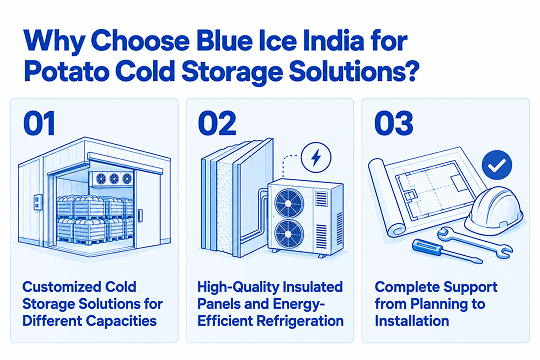
Every farm and plot is different, so we plan each potato cold storage project around your capacity, crop, budget, and land. Whether you need 1,000 MT or a larger plant, the layout is made for you.
Blue Ice India uses high-quality insulated PUF panels and energy-efficient refrigeration systems. This keeps the temperature steady and your power bills under control.
Our team supports you from site survey and design to installation and after-sales service, so you deal with one partner from start to finish.

A well-planned potato cold storage facility protects your crop, earns steady rent, and can qualify for government subsidy. Focus on the right temperature, strong insulation, and good planning. With the right partner, you can build a plant that pays back for years.
Kalpesh Bhuva, CEO of Blue Ice India, brings over 25 years of expertise in refrigeration and cold chain solutions. He specializes in cold storage, modular cold rooms, multi commodity cold storage, ripening chambers, pharma facilities, and more. His vision focuses on innovation, quality, and advancing sustainable, locally manufactured cold storage technologies across India.

Queries
Yes. Once potato stocks are cleared, many owners rent the chambers to other crops in the off-season. This extra income keeps a potato cold storage in India earning year-round instead of sitting empty.
At 2°C to 4°C, table potatoes turn slightly sweet. Keeping them at a warmer temperature for a few days before sale fixes this. For chips and fries, a potato cold storage is set at 10°C to 12°C so sugar stays low from the start.
Usually not. NHB and MIDH offer 40% subsidy in general areas and 55% in hilly and scheduled areas for potato cold storage in India, up to 5,000 MT per project. Apply before construction begins, because projects started early may not qualify.
Uneven air flow, not machine failure. Stacks in corners or at the top can stay warmer than the rest. A good potato cold storage checks temperature at different heights and corners and keeps humidity between 85% and 95%.