Potatoes (Solanum tuberosum) constitute one of India’s key tuber crops grown across many states (Uttar Pradesh, West Bengal, Punjab, Madhya Pradesh etc.). But despite strong production, India faces significant post-harvest losses and inefficiencies in the storage chain.
According to ICAR Agmarknet data, proper cold-storage at low temperature 2-4 °C extends storage life and allows table/seed/processing potatoes to be available through the year.
The crop’s value chain is sensitive to temperature, humidity, sprouting, physiological deterioration and weight loss. As noted, “Without a cold‐storage facility, potatoes are prone to diseases, bruising, sprouting, and even dehydration.
India’s cold-chain infrastructure for perishables still has gaps: for example, many storage facilities are not integrated with handling, cooling, sorting and logistics for potatoes this means higher losses and missed market windows. The existence of the National Centre for Cold-chain Development (NCCD) as a nodal think tank underlines how critical this is for India.
- Let’s dive into the three most important environmental parameters and how they specifically apply in India.
- Ensure the Temperature
- Seed potatoes: Very low temperatures 2-4 °C may be required for long-term dormancy.
- For table/fresh consumption: Typically, 4-7 °C is recommended.
- Processing (chips/fries): Storage at slightly higher temps 7-10 °C is sometimes used to avoid excessive sugar build-up.
- Avoid storage below 3-4 °C for table processing types because too low a temperature may trigger starch to sugar conversion (Maillard reaction) leading to dark fries/brown spots.
- In the Indian ambient context (warm, humid summers and high ambient heat loads), insulation, chilling capacity and uniform cooling are major design challenges.
- Relative humidity (RH) levels of 90-95% are recommended for potato curing and storage to minimise weight loss and maintain quality.
- However, too much moisture or condensation can trigger microbial growth, so moisture control and ventilation are key.
- Especially in Indian settings, humidity control is harder due to monsoon seasons, high ambient RH and variable ventilation.
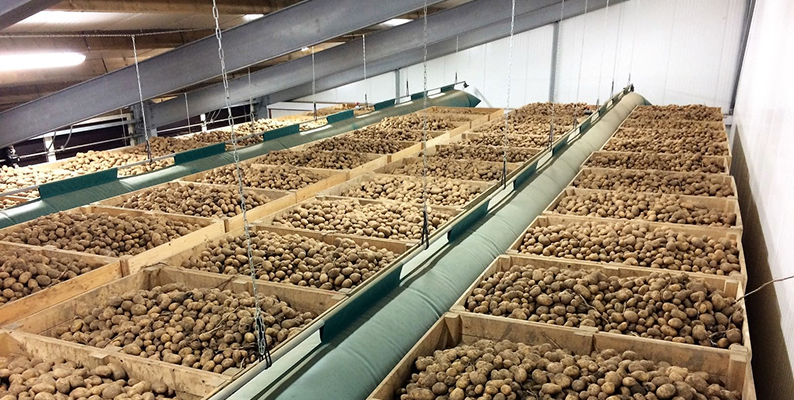
- Uniform airflow ensures removal of heat and gas (CO₂) from inside the pile, avoiding hot spots, moisture gradients or local condensation. A poorly ventilated stack may see spoilage, sprouting or weight loss.
- Example: The science of potato respiration heat accumulation can elevate pile temperature by 2-3 °C daily in unventilated sheds.
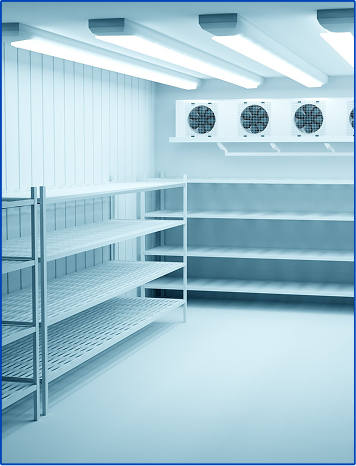
- In India, the design of cold-storage rooms must consider both insulation and airflow. Many legacy storages, especially in rural areas, may lack adequate ventilation or uniform cooling, affecting quality outcomes.
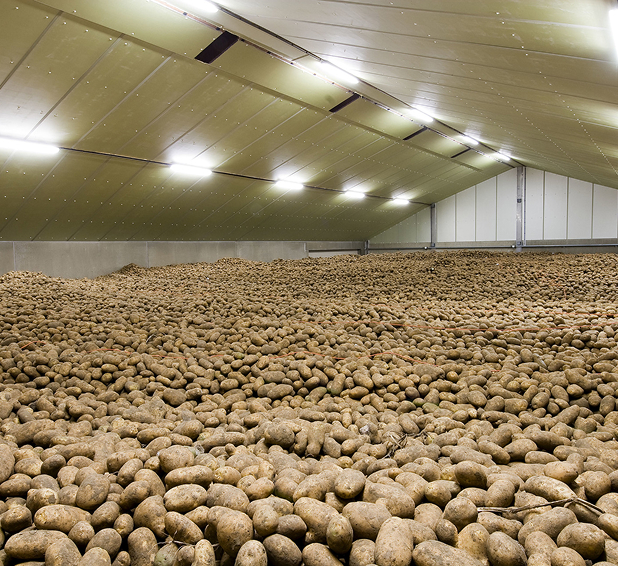
- Light exposure: Even small light exposure can cause greening of potatoes (solanine accumulation), affecting food-safety and appearance.
- Atmospheric gases: CO₂ and O₂ levels affect respiration and quality; some advanced facilities adopt controlled‐atmosphere measures.
- Sorting & grading: To ensure only sound tubers are stored, minimising diseased or damaged ones that create hotspots or encourage rot.
- Storage duration & turnover: The longer the storage, the more demanding the conditions and the cost implications.
This is the main long-term storage phase. Key parameters: temperature, RH, ventilation, and darkness.
- Seed potatoes: 2-4 °C for long-term hold.
- Table/Fresh potatoes: 4-7 °C.
- Processing potatoes (chips/fries): -7-10 °C to minimise sugar accumulation.
- Duration: Many Indian studies show that storage up to 6 months (or more) is feasible with proper conditions.
- During this period
- Monitor for sprouting, weight loss, moisture loss, rot.
- Maintain dark conditions (to prevent greening).
- Maintain high RH 90-95% but ensure ventilation so moisture doesn’t condense.
- Use air circulation to remove CO₂ and heat from respiration.
- Ensure power reliability back-up India’s rural power supply may be variable.