We are ISO certified
Cold Storage Company
We are ISO certified
Cold Storage Company
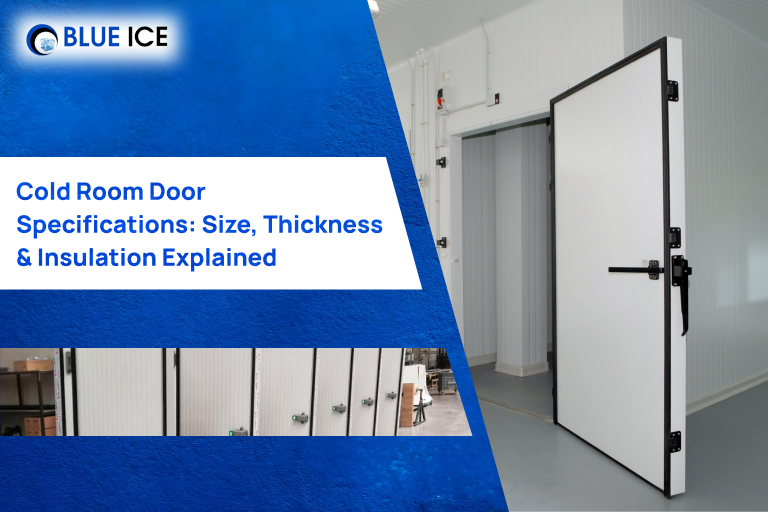
When people build a cold storage facility, they mainly keep their focus on the wall panels and the cooling unit. However, the cold room door is also a crucial component of a cold storage facility.
Think of it as the gatekeeper of your inventory. If the door isn’t the right type or isn’t built with the right material, cold air will escape.
This will significantly increase your electricity bills, and your products will also be spoiled. Selecting an appropriate door ensures your cooling unit does not run overtime to compensate for leaks.
The guide will explain the essential information on size requirements, thickness specifications, and insulation characteristics of the cold room door in simple terms.
Choosing the right size for your cold storage facility depends on the types of machines and containers that go in and out of your room.
Standard doors are usually cheaper and they can be installed quickly. This makes them a good choice for small walk-in coolers used in floral shops and restaurants.
But if you have a large warehouse, a custom-sized door is the right choice. Custom doors are designed to accommodate specific machinery entering and exiting the warehouse, such as tall pallet jacks or wide forklifts.
The “Clear Opening” is the usable space available once the cold room door is fully open. People often measure the door leaf instead of the actual opening.
The clear opening needs to be 10 to 15 percent wider than your largest pallet or trolley.
In this way, you can keep your door gaskets and frame protected from accidental damage, which can lead to energy loss and costly repairs.
If you store items such as fruits, dairy products, or pharmaceuticals, you need a “chill room” where the temperature remains above 0°C. The standard door thickness should be 60 mm to 80 mm for these environments.
A thin door can be used for a chill room if there’s little difference between the warehouse’s inside and outside temperatures.
For a deep-freeze or blast-freezer storage unit where temperatures drop well below -18°C, the door thickness is non-negotiable. In these storage units, you need a door with a thickness of 100 mm to 120 mm, or more.
The cold room door requires additional thickness to provide thermal protection and prevent outside heat from entering the building.
Therefore, thick doors are required because they don’t let the ‘sweat’ develop, as in the case of condensation, where ice damages the door seals.
You can also read this blog to know more about How Cold Rooms Improve Food Safety and Extend Shelf Life
Most cold room doors used today are built with a layer of PUF (Polyurethane Foam). A cold door should have a PUF layer because it is lightweight yet highly effective at preventing cold air from escaping.
The door system functions as a high-tech insulator, preventing heat transfer through its metal exterior.
It also depends on the density of the PUF, which determines how much cold air is going to escape through the door. High-density PUF, typically 40–42 kg/m3, ensures there are no air gaps within the door.
A denser PUF also provides structural strength to the door, enabling it to withstand hundreds of openings and closings per day without warping.
A “thermal break” is a barrier that prevents the flow of heat. In case of cold doors, a layer of non-conductive material is placed inside the door frame and inside the door, so that they don’t let the warm air come inside the cold storage room In this way, it prevents frost buildup on the interior.
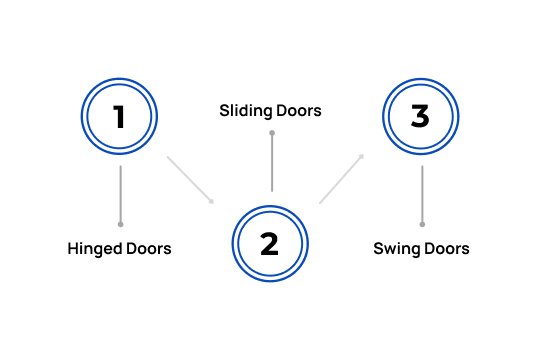
Hinged doors look exactly like standard doors and they are usually the first choice for people who are building small to medium-sized cold rooms.
They provide a very tight seal and are also very easy to use. However, these doors require “swing space,” so you cannot keep goods within the area where they swing open and close.
Sliding doors are the heroes of large warehouses. They don’t require swing space. They move along the wall, which enables you to use a large portion of the floor space.
They can be controlled in both ways – manually or automatically.
Because these doors do not swing, they are suitable for warehouses with continuous forklift traffic.
Swing doors are also known as “impact doors” because they can be pushed open from both sides and swing back to their closed position on their own.
These doors are perfect for those places where workers move in and out quickly, again and again, with their hands full.
A gasket is a rubber strip attached along the edge of the door. A high-quality, multi-layered gasket helps to seal the cold room completely.
If you see light or feel a breeze coming out through the edge of the cold room door when it is closed, it means the door is not sealed and you are losing profit.
In freezer rooms, moisture in the air can freeze the door shut against the frame. To solve this problem, special heating wires are installed inside the door frame.
These heating wires keep the door’s edge just warm enough to stop the ice from forming, so the door can open without obstruction.
No matter what industry we are working in, safety should be our priority. Every cold room door must have an internal safety release (which security experts refer to as “emergency glow-in-the-dark handle”).
So, in case someone’s accidentally locked inside the cold room, they can open the door from the inside, even if it is padlocked from the inside.
Blue Ice India is your go-to partner if you are looking for a reliable cold storage and room manufacturer. Our company is the leading cold room manufacturer in India, delivering customized, high-performance environments that meet your specific business requirements.
Beyond full installations, Blue Ice India also provides the service of high-quality cold room doors that are designed to fit in new as well as existing facilities.
Whether you need a custom-sized door or need to replace an old, leaking door, we offer the right technical expertise to build doors with an airtight seal.
Expert Solutions
Every industry is different. That’s why we believe a different approach is needed to deliver comprehensive solutions for cold storage businesses.
Our company delivers expert technical solutions for designing your commercial space, whether you are building a small retail refrigeration unit, a large industrial cold storage facility or just installing a new cold room door.
Our status as the best cold room manufacturer comes from our dedication to delivering precise solutions.
Quality Manufacturing
As a leading cold room manufacturer in Ahmedabad, we take pride in our manufacturing excellence. We help you build the perfect and most efficient cold storage room and cold room door, which are well-equipped with high-density PUF insulation and heavy-duty hardware.
Our rooms and doors are built to withstand the hot and humid Indian weather conditions while reducing your energy usage.
Full Support
Blue Ice India provides complete assistance to you, right from your warehouse design process to your modular panel and door installation. We offer customized services so that you always get the best solution as per your business needs.
The best way to safeguard your business is to know about cold room door specifications. By choosing a door of the right size, correct thickness and high-density insulation for your temperature needs, you can create a facility that is both energy efficient and durable.
Kalpesh Bhuva, CEO of Blue Ice India, brings over 25 years of expertise in refrigeration and cold chain solutions. He specializes in cold storage, modular cold rooms, multi commodity cold storage, ripening chambers, pharma facilities, and more. His vision focuses on innovation, quality, and advancing sustainable, locally manufactured cold storage technologies across India.

Queries
Standard cold room door sizes vary based on usage, but they are typically suitable for small to medium applications. For larger warehouses, custom-sized doors are recommended to accommodate forklifts and large equipment.
For chill rooms (above 0°C), door thickness should be 60–80 mm. For freezer rooms (below -18°C), a thickness of 100–120 mm or more is required to maintain proper insulation.
PUF (Polyurethane Foam) insulation is the most commonly used due to its excellent thermal efficiency, lightweight structure, and durability.
Clear opening ensures smooth movement of goods. It should be 10–15% wider than the largest pallet or trolley to prevent damage and maintain proper sealing.
A good cold room door should include strong gaskets, high-density insulation, thermal breaks, heater wires (for freezer rooms), and an internal safety release system.