We are ISO certified
Cold Storage Company
We are ISO certified
Cold Storage Company
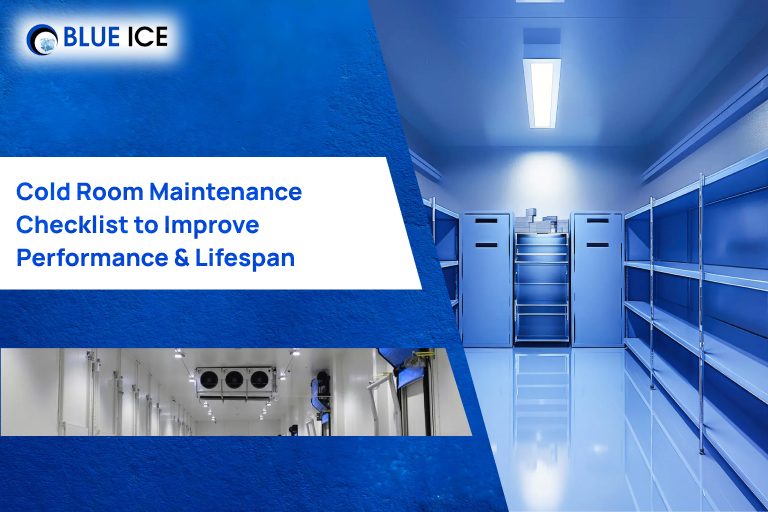
For any business dealing in perishable goods is the single most important unit for them. If your cold room is not working in its perfect condition, then, along with losing cold air, you are also losing profit through potential stock spoilage and high electricity bills.
Regular maintenance is the obvious solution to ensure your facility runs smoothly for decades. In this guide, we have divided a simple cold room and cold storage room maintenance checklist into daily, monthly, and yearly tasks that will help you to keep your cold storage unit in perfect condition, improve efficiency, and maximize its lifespan.
You don’t have to be an expert in the science behind the cold storage technology to keep your facility’s health under check.
Some simple tasks and habits will be able to catch a small problem before it turns into a bigger one and crashes the entire system.
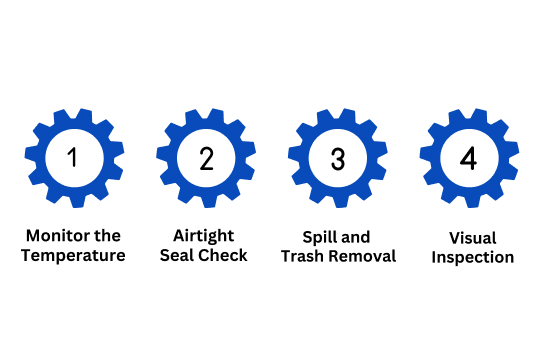
Cold room temperature is the most important factor for any facility. You need to check your digital controller at least twice a day. If the temperature is slowly rising, it means your cooling unit might be overworking.
Make sure the thermometer you have installed inside the cold room has a monitor screen outside it, so that you can check the correct temperature whenever you want.
If the seal of the cold room door specifications has loosened up or it’s not in the right place on the edge of the door, the cold air will be escaping continuously even if the door is closed.
It will also let the moisture inside the cold room, where it will convert into ice after heavy energy usage.
You should also keep your floor clean. Spilled liquids on the floor freeze, which further invites mold and increases the risk of slips.
Removing spills, trash, and old packaging will also help in maintaining high hygiene standards and keep the place odor-free.
Evaporator fans should also be checked regularly. Make sure they are spinning properly. If any snow or frost is forming on the walls, then you should clean it, as it would put too much burden on your compressor.
Once a month, you should take a closer look at the components that keep your cold room in good working order.
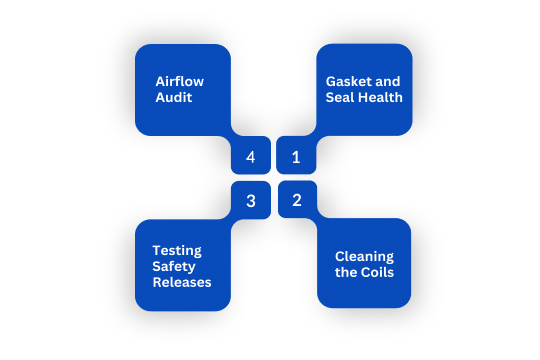
The rubber gaskets fitted on the edge of the door and door frame prevent cold air from escaping the room.
Check for any cracks, stiffness, or gaps in the gaskets by placing your hand there. If you feel any cold breeze, that means the cold air is leaking through it.
Dust also reduces the efficiency of the cold room. If there is dust settled on the condenser and evaporator, then the system will work under a burden to maintain the cold storage temperature. Therefore, it is advised to gently clean the coils to keep the system in a healthy condition.
Safety is non-negotiable in every industry. To ensure the safety of workers, test the internal emergency release handle on the door.
The door handle should be working fine, so that even if the cold room is padlocked from the outside, every worker should be able to exit the room easily.
Check how your stock is stored in the cold room. If the boxes are stacked closer to the ceiling or if they are placed against the cooling fans, it will affect the proper circulation of cold air.
You need to leave at least a 12-inch gap from the ceiling and walls to ensure every corner of the room receives sufficient cold air.
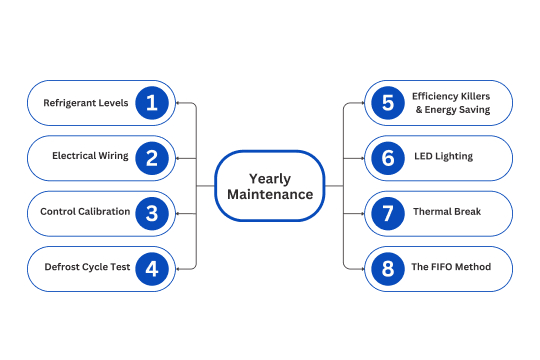
While daily and monthly maintenance tasks can be done by workers, a proper health check-up should be done by a professional technician once a year.
A low refrigerant level signals that there is a leak in the system. A technician’s job is to check the “gas” pressure to ensure your cold room isn’t burning out while functioning.
Cold environments can also damage or alter the condition of electrical wires. A professional inspects the electrical system of the cold storage unit, checks for loose connections, frayed cables or signs of wear that could lead to a short circuit or fire hazard.
Over time, sensors also lose their accuracy. Yearly calibration of sensors ensures that the temperature reading on the screen is equal to the actual temperature inside the cold room.
Sometimes, ice formed by the moisture also chokes the system. This ice is defrosted by heaters. A technician’s job is to check if the timer and heaters are working at their best to keep your facility frost-free.
Apart from maintenance issues, there are some other factors that also affect the efficiency of cold storage units. Here are some methods that will help you to increase your cold room’s efficiency.
Standard bulbs release heat, which will force your cooling unit to work harder. But LED Lights release minimal heat and support better cooling for the entire unit.
A “Thermal Break” is a barrier at the metal frame of the door that stops cold air inside the room from escaping. Properly installed thermal breaks prevent cold air from leaking out of the room, and it also prevents ice frosting inside the room.
FIFO (First In, First Out) is not just about food safety; it is also about the efficiency of the cold storage unit. In an organized store, workers can quickly find the items stored in the room, meaning they won’t need to keep the door open for a long time.
Even the best maintenance methods will not deliver results if your cold storage facility is not built properly.
That’s why people chose Blue Ice India, a renowned cold room manufacturer in Ahmedabad, to build cold rooms and for their proper maintenance.
Blue Ice India is a leading cold room manufacturer in India, and businesses trust us because we provide state-of-the-art cold storage solutions across the country.
We specialize in using high-density PUF panels (40-42 kg/m3) that offer superior insulation than the standard builds.
Whether you need a custom-sized cold room door to seal your cold warehouse or you are looking to build an entire cold storage facility, Blue Ice India designs systems that work with maximum efficiency, can withstand the demanding Indian climate, and are easy to maintain.
Maintenance of the cold room cannot be ignored if you want to run your cold warehouse at its best. By following the above-mentioned daily, monthly, and yearly checklists, you can save your facility from emergency repairs and ensure that your inventory stays safe.
And, as a premier cold room manufacturer in Gujarat, Blue Ice India can help you to build a system that works well and lasts for decades.

Kalpesh Bhuva, CEO of Blue Ice India, brings over 25 years of expertise in refrigeration and cold chain solutions. He specializes in cold storage, modular cold rooms, multi commodity cold storage, ripening chambers, pharma facilities, and more. His vision focuses on innovation, quality, and advancing sustainable, locally manufactured cold storage technologies across India.

Queries
The ideal cold storage temperature depends on the type of food. Fresh vegetables are usually stored between 0°C and 10°C, dairy products at 1°C to 4°C, while frozen foods require temperatures below -18°C to maintain quality and prevent bacterial growth.
Maintaining the right temperature helps slow down bacterial growth, preserves nutrients, and extends the shelf life of food. Proper cold storage also prevents spoilage, reduces food waste, and ensures food safety.
For long-term preservation, meat and seafood should be stored at around -18°C. For short-term storage, a temperature range of -2°C to 5°C is recommended to maintain freshness and prevent bacterial growth.
Most vegetables stay fresh between 0°C and 10°C, while fruits require temperatures ranging from -1°C to 13°C depending on the variety. Tropical fruits like bananas and mangoes should be stored at slightly warmer temperatures.
Improper temperature control can cause food spoilage, frost buildup, texture changes, and bacterial growth. Consistent cold storage temperatures are essential to maintain food quality, safety, and shelf life.