We are ISO certified
Cold Storage Company
We are ISO certified
Cold Storage Company
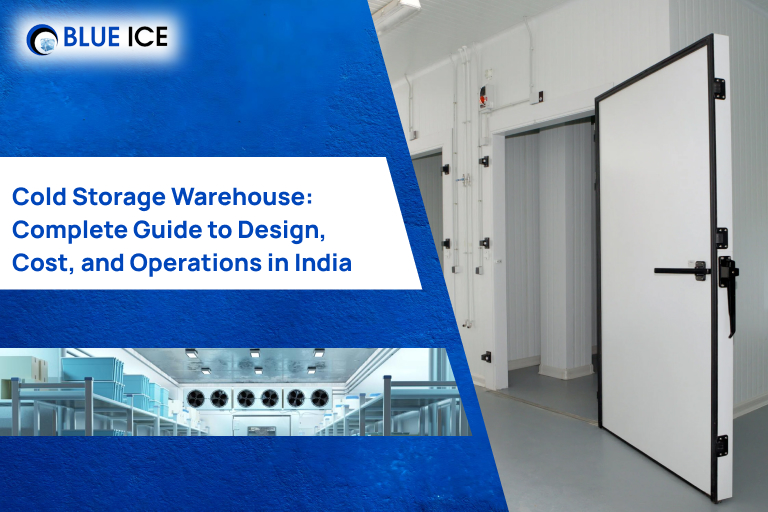
India’s food supply chain has a serious problem because a large share of fruits and vegetables is lost before they even reach consumers. A well-planned cold storage warehouse can change that.
Whether you are a farmer, a food business owner, or a logistics entrepreneur, understanding how cold chain infrastructure works can save you significant money and help you scale your business with confidence.
So, what exactly is cold storage warehouse infrastructure? In simple terms, it is a temperature-controlled facility designed to store perishable goods like fruits, vegetables, dairy, meat, seafood, and medicines at specific temperatures to slow down their decay.
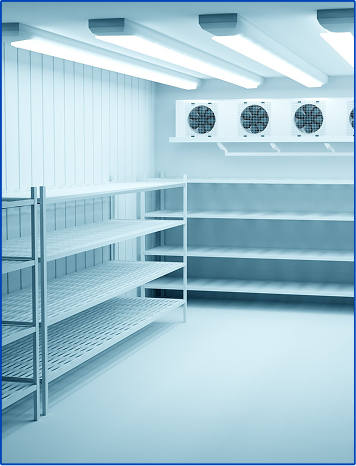
These warehouses maintain different temperature conditions depending on the type of product being stored, from deep frozen goods to fresh produce that needs only mild cooling. The infrastructure includes insulated rooms, refrigeration systems, monitoring equipment, and proper loading areas to handle goods safely and efficiently.
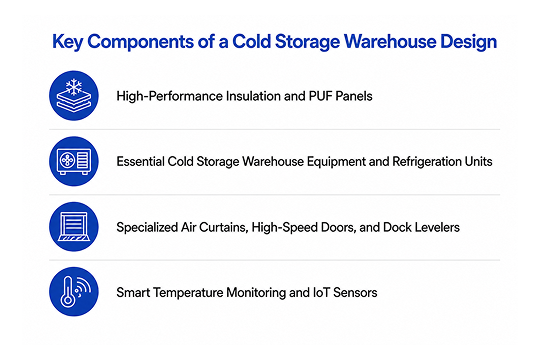
The walls, floors, and ceilings of a cold storage warehouse are built using PUF panels. These panels lock the cold air inside and stop heat from entering. Good quality PUF panels with the right thickness can reduce energy loss dramatically and keep your compressors from working overtime.
Cold storage warehouse equipment includes condensing units, evaporators, compressors, and refrigerant piping. Choosing the right refrigeration unit based on your storage capacity and product type is critical. Undersized equipment leads to temperature failure, while oversized equipment wastes electricity unnecessarily.
Every time a door opens, warm air rushes in. Air curtains, high-speed roll-up doors, and dock levelers at loading bays minimize this warm air infiltration. These additions may seem small, but they can make a noticeable difference to your monthly electricity bill.
Modern cold storage facilities use IoT-based temperature loggers and remote monitoring systems. These send real-time alerts if the temperature goes out of range, giving you time to act before your entire inventory is at risk.
Cold storage warehouse cost varies based on size, location, and the type of products you plan to store. Smaller facilities designed for limited capacity require a lower upfront investment, while large multi-commodity warehouses involve significantly higher capital. Getting a proper project estimate from a qualified consultant before you begin is always the smarter move.
PUF panel installation is one of the major cost heads in any cold storage construction project. Opting for high-density, high-quality panels may cost more upfront, but it saves heavily on recurring power bills over the life of the facility.
Electricity is the single largest recurring expense in cold storage operations, making up a major portion of monthly running costs. The better your insulation and refrigeration design is, the lower your power consumption will be month after month.
The Indian government actively supports cold chain development. Under the NHB (National Horticulture Board) and NCCD (National Centre for Cold-chain Development) schemes, eligible businesses can receive substantial subsidies on their total project cost. These incentives make cold storage a highly viable investment for agri-entrepreneurs and food businesses today.
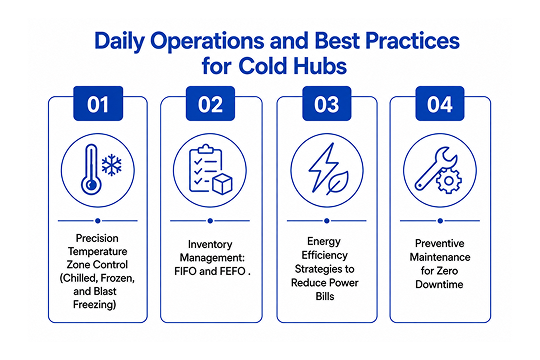
A well-operated cold storage warehouse maintains separate temperature zones for different product types. Chilled rooms are used for fresh produce and dairy, frozen rooms for meat and processed foods, and blast freezers for rapidly bringing down the temperature of freshly processed goods. Using each zone correctly prevents cross-contamination and product damage.
Good cold storage operations follow FIFO (First-In, First-Out) to ensure older stock moves out before newer stock. For products with expiry dates like pharmaceutical goods, FEFO (First-Expired, First-Out) is followed instead. These simple practices reduce wastage and help maintain consistent product quality.
Simple operational habits make a big difference. Keeping doors closed, scheduling defrost cycles during off-peak hours, using energy-efficient lighting, and installing VFD (Variable Frequency Drive) compressors can bring down energy costs in a meaningful way over time.
Regular checks on refrigerant levels, condenser cleaning, gasket inspection, and compressor servicing prevent sudden breakdowns. A refrigeration failure during peak summer can cause losses worth lakhs within just a few hours, making preventive maintenance one of the most important investments in cold storage operations.

Many business owners try to save money by designing their cold storage facility without expert help. But they end up making a facility that often has poor insulation, undersized equipment, and energy leaks that cost far more to fix later than they would have cost to avoid in the first place. Experienced cold storage warehouse consultants and manufacturers prevent these costly mistakes at the planning stage itself.
A good Cold Storage Room Manufacturer in India brings in-house engineering capability, quality-tested PUF panels and refrigeration equipment, and the experience to handle complex multi-commodity facilities. Always check their past projects, manufacturing standards, and client references before finalizing a manufacturer for your facility.
Cold storage facilities that store food products must comply with FSSAI (Food Safety and Standards Authority of India) guidelines. This includes maintaining temperature logs, hygiene standards, pest control measures, and proper labeling protocols. A reliable manufacturer ensures your facility is built to meet these requirements from day one.
Choosing the right cold storage partner is equally important. Read our guide on how to choose the right cold storage manufacturer to ensure quality construction, reliable refrigeration systems, and long-term operational efficiency.
Blue Ice India is an ISO-certified Cold Storage Room Manufacturer in India, headquartered in Ahmedabad, Gujarat, with decades of experience in cold chain solutions. We design and build end-to-end cold storage infrastructure for food processing companies, pharmaceutical firms, agri-businesses, and logistics providers across India and Nepal.
We build a multi-commodity cold storage warehouse that can store different products, from fruits and vegetables to ice cream and pharmaceutical goods, under the same roof using separate temperature zones. Our team handles everything from site feasibility and layout design to panel installation, refrigeration commissioning, and project handover.
India’s hot and humid climate puts extra strain on refrigeration systems. We select and install refrigeration equipment that is specifically rated for high ambient temperatures, ensuring consistent performance even during the harshest summer months when outdoor temperatures soar across many parts of the country.
Leading food processing brands, agri-exporters, and logistics companies across India have trusted us with their cold chain requirements. Our clients consistently highlight our energy-efficient systems, quality materials, and fast response to service calls.
As an experienced Cold Storage Room Manufacturer in India, we bring the full package, such as design, supply, installation, and after-sales support, under one roof.
Building or upgrading a cold storage warehouse in India is a smart investment, especially with growing demand across food, pharma, and e-commerce sectors. Understanding what is cold storage warehouse design, knowing the cold storage warehouse cost upfront, choosing the right cold storage warehouse equipment, and working with qualified cold storage warehouse consultants can make the difference between a profitable facility and an expensive mistake.
Kalpesh Bhuva, CEO of Blue Ice India, brings over 25 years of expertise in refrigeration and cold chain solutions. He specializes in cold storage, modular cold rooms, multi commodity cold storage, ripening chambers, pharma facilities, and more. His vision focuses on innovation, quality, and advancing sustainable, locally manufactured cold storage technologies across India.

Queries
A cold storage warehouse is a temperature-controlled facility used to store perishable products such as fruits, vegetables, dairy items, frozen foods, pharmaceuticals, meat, and seafood. By maintaining specific temperature and humidity conditions, these warehouses help preserve product quality, extend shelf life, and reduce spoilage throughout the supply chain.
Cold storage warehouses are essential for India’s agriculture, food processing, pharmaceutical, and logistics sectors. They help reduce post-harvest losses, maintain product freshness, support exports, and ensure year-round product availability. As demand for temperature-sensitive products continues to grow, cold storage infrastructure has become increasingly important across the country.
The cold storage warehouse cost in India depends on several factors, including the size of the facility, storage capacity, refrigeration requirements, insulation quality, location, and level of automation. Smaller facilities may require a modest investment, whereas large industrial cold storage projects can involve significantly higher capital expenditure. Costs typically include land acquisition, construction, refrigeration systems, insulation panels, electrical infrastructure, and operational setup.
A cold storage warehouse is designed with a focus on temperature control, energy efficiency, and operational flow. The facility typically includes insulated wall and roof panels, vapor barriers, refrigeration systems, temperature monitoring equipment, storage racks, loading docks, and backup power systems. Proper airflow management and space utilization are also critical aspects of warehouse design.
Cold storage warehouses are widely used across industries that handle temperature-sensitive products. Agriculture, food processing, dairy, seafood, meat processing, pharmaceuticals, biotechnology, chemicals, retail, and e-commerce businesses all depend on cold storage facilities to maintain product integrity during storage and distribution.