We are ISO certified
Cold Storage Company

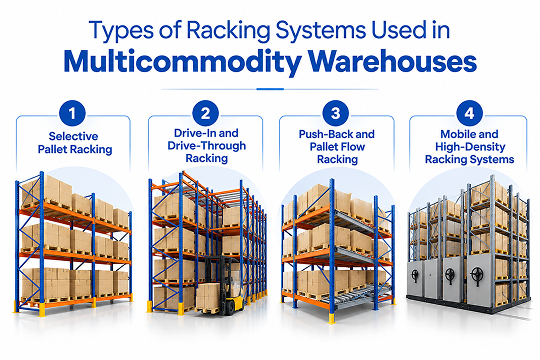
Every multi commodity warehouse has different needs, so no single rack suits all of them. Here are the four most common types.
Selective racking gives direct access to every pallet. It is simple and flexible, and it is ideal when you store many different products in small lots.
In drive-in racking, forklifts enter the rack lanes to place and pick pallets. It saves aisle space and suits large quantities of one product. Drive-through racking is open at both ends, which makes first-in, first-out handling possible.
Push-back racking stores pallets on slightly sloped rails, so each new pallet pushes the older ones back. Pallet flow racking uses rollers and gravity to bring pallets forward, which suits perishable goods that need strict stock rotation.
Mobile racks sit on motorised bases and slide together, so you need only one open aisle at a time. This gives very high storage density, which is valuable in costly freezer space. The trade-off is slower access to individual pallets.
Good design decides how well a multi commodity cold storage warehouse performs for years. Keep these five points in mind.
Start with the products you plan to store, their volumes, and how fast they move. Then decide how many chambers you need and how big each one should be. Leave room for growth so you do not have to rebuild later.
Fruits, dairy, meat, and medicines all need different conditions. A multi commodity cold storage warehouse uses separate zones with their own cooling units, so each product gets exactly what it needs. Keep strong-smelling products away from sensitive ones.
Check the weight, size, and type of your pallets before choosing racks. Heavy, slow-moving goods suit dense systems, while light, fast-moving goods suit selective racks. Make sure the steel and finish are suitable for low temperatures.
PUF panels keep outside heat away and protect both your goods and your power bills. Freezer chambers need thicker panels than chiller chambers. Refrigeration must match the load of each chamber, with backup for power cuts.
Leave enough aisle width for forklifts to turn safely. Keep gaps between racks and walls so cold air can move freely. Poor airflow creates warm spots, and warm spots spoil stock.
Planning experts usually fix the pallet size and the cooling load first, and choose racks second. This order avoids expensive changes after installation, because racks, panels, and refrigeration all depend on each other.
Land, building size, panel thickness, rack type, rack height, and refrigeration capacity all affect the budget. A multi commodity cold storage warehouse with many temperature zones costs more to build than a single-zone store, but it can serve more customers. Always compare detailed quotations, not just a headline price.
Taller racks use vertical space that would otherwise go unused. Dense systems like drive-in and mobile racks store more pallets in the same area. More pallets per square foot means a better return from every rupee spent on the building.
Good insulation and tight doors reduce the power needed for cooling. A smart layout cuts forklift travel, which saves labour and fuel. Regular servicing of racks, doors, and compressors prevents costly breakdowns.
Use barcodes or simple software to track every pallet. Follow first-in, first-out so older stock moves first. Train forklift operators, and never go beyond the load limit shown on the rack.
Racks should be inspected regularly for bent beams, loose bolts, and damaged uprights. A written inspection record shows customers and auditors that safety is taken seriously.
Choosing the right cold storage racking system is a balance between capacity, access, and budget. These three checks make the decision easier.
Selective racking offers the easiest access but the lowest density. Drive-in, push-back, and mobile systems store more in less space. Pick the option that fits the number of products you handle.
Perishable goods need first-in, first-out rotation, so pallet flow or drive-through racks work well. In a multi commodity cold storage warehouse, different chambers may even need different rack types. Always match rack strength to your heaviest pallet.
Your business will grow, so choose racks that can be extended or upgraded. Ask whether the layout can later support shuttle systems or warehouse software. A multi commodity cold storage facility that can grow in stages protects your investment.

Blue Ice India designs and builds cold storage facilities for businesses across Gujarat. If you want a multi commodity cold storage warehouse that is planned well from day one, the team can guide you from idea to handover. It offers multi commodity storage solutions for farmers, processors, and traders.
The team plans projects from real site experience, not just drawings. This helps catch problems with layout, airflow, and rack placement early, before they become expensive.
Every business has different products, volumes, and growth plans. Blue Ice India designs each multi commodity cold storage chamber layout around those needs, so no space or power is wasted.
Blue Ice India plans racking, PUF insulation, and refrigeration together, so they work as one system. A matched cold storage racking system, well-insulated chambers, and efficient refrigeration help a multi commodity cold storage warehouse stay cool, stable, and economical.
From early consulting and design to installation and support, one team handles the whole project. This saves time, keeps responsibility clear, and avoids confusion between different vendors.
A space-efficient facility starts with the right design, the right racking, and the right partner. Plan your temperature zones, match racks to your products, and think about growth from the start.
A well-built multi commodity cold storage warehouse can serve many industries and earn steadily through every season.