We are ISO certified
Cold Storage Company
We are ISO certified
Cold Storage Company
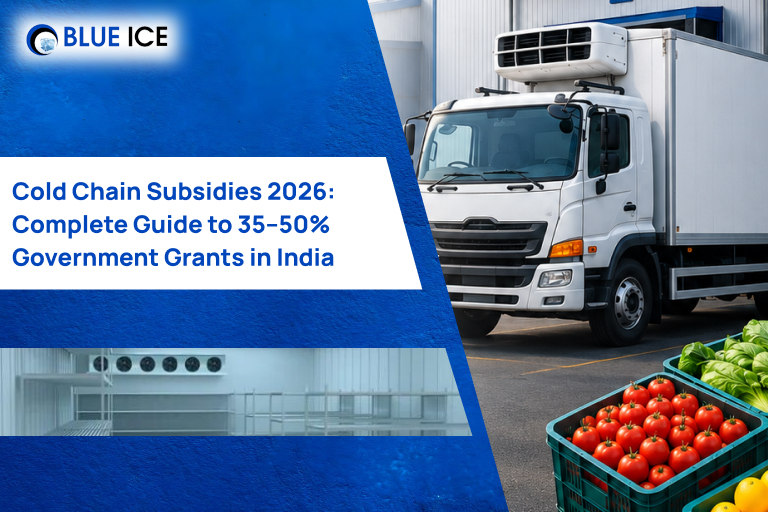
If you are planning to set up a cold storage unit in India, 2026 is a good year to do it with government help. The central government, through schemes like PM Kisan SAMPADA Yojana, is offering a cold storage subsidy of 35% to 50% on your project cost. For every ₹1 crore you spend on a cold room, chiller, or reefer vehicle, the government can pay back ₹35 lakh to ₹50 lakh, up to a cap of ₹10 crore per project.
This guide breaks down every cold storage government subsidy scheme, every percentage, and every step needed to get this money released into your account, in plain language, without the jargon that usually makes these government circulars hard to follow.
This is the biggest and most well-known scheme for cold storage projects, run by the Ministry of This is the biggest and most well-known scheme for cold storage projects, run by the Ministry of Food Processing Industries (MoFPI), covering everything from pre-cooling at the farm to storage, transport, and processing.
In July 2025, the Union Cabinet added ₹1,920 crore to this scheme, taking the total outlay to ₹6,520 crore for the 15th Finance Commission cycle, showing the government has been increasing cold chain funding rather than slowing it down.
Businesses applying now should check the SAMPADA portal for the latest allocation cycle, since fresh outlays are typically announced as each cycle draws to a close.
NHB runs the Capital Investment Subsidy scheme, a back-ended subsidy: the bank disburses your loan first, and once the project is verified, the subsidy is credited against your loan account. It covers storage capacities from 5,000 MT to 20,000 MT.
MIDH supports pack houses, ripening chambers, and pre-cooling units, often alongside NHB and PMKSY funding on the same project.
If your project is linked to milk or dairy products, NPDD offers separate support for bulk milk coolers and chilling centres.
In most states, a cold storage government subsidy is capped at 35% of the eligible project cost. This applies to general areas across states like Gujarat, Maharashtra, and Tamil Nadu.
In difficult areas, such as the North-Eastern states, Sikkim, Uttarakhand, Himachal Pradesh, Jammu & Kashmir, or Ladakh, the subsidy jumps to 50% of the eligible cost.
Regardless of location, if your project is set up by a Farmer Producer Organisation (FPO), a Self Help Group (SHG), or an SC/ST applicant, you also qualify for the 50% slab.
No matter how large your project is, the total grant is capped at ₹10 crore. Even a very large cold storage facility only gets support up to this ceiling; the rest comes from your own funds and bank loan.
State governments layer their own top-ups on this central grant, and these change every budget cycle, so it is important to keep your knowledge up to date. Someone researching subsidies for cold storage in Gujarat will find the state agro-industries department adding its own incentives.
The pattern repeats elsewhere too: cold storage subsidy in UP is often tied to district-level horticulture programmes, cold storage subsidy in Punjab usually runs through the state agro-industries corporation, and cold storage subsidy in Odisha is routed through the state food processing department.
Eligible components include:
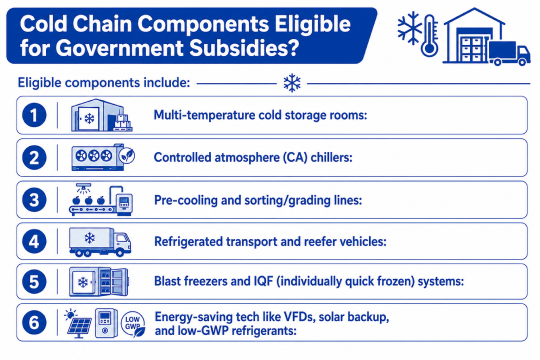
Multi-temperature cold storage rooms: Rooms that can be set to different temperatures for different produce, so you are not limited to one type of goods
Controlled atmosphere (CA) chillers: Storage that also controls oxygen and humidity levels, keeping fruits fresh for much longer
Pre-cooling and sorting/grading lines: Equipment that cools produce right after harvest and sorts it by size and quality before storage
Refrigerated transport and reefer vehicles: Trucks that keep produce cold while it travels from the farm or warehouse to the market
Blast freezers and IQF (individually quick frozen) systems: Machines that freeze food very fast so each piece stays separate and does not clump together
Energy-saving tech like VFDs, solar backup, and low-GWP refrigerants: Equipment that cuts your electricity bill and is kinder to the environment
Applications most often get rejected for the following reasons:

Blue Ice India is a Gujarat-based cold storage solutions manufacturer that designs and builds cold rooms, chillers, and refrigeration systems for agribusiness and food processing clients. Our focus on subsidy-ready design helps businesses avoid the technical pitfalls that commonly derail government funding applications.
Here is how they help you build right and get your subsidy approved without delays.
The technical audit is where most cold storage subsidy applications actually fail, not at the paperwork stage. If your refrigeration design, insulation panels, or cold room layout do not match what your DPR promised, your claim can be delayed or rejected outright.
This is where working with an experienced partner like Blue Ice India makes a real difference. Blue Ice India designs modular cold rooms, multi-temperature chillers, and blast freezing systems built to match the technical specifications banks and government auditors expect, right from the DPR stage.
Their engineering team keeps every drawing, capacity figure, and equipment spec aligned with NHB and MoFPI guidelines, so your project moves through physical verification instead of getting stuck there.
Blue Ice India also focuses on energy-efficient refrigeration, which lowers running costs after the subsidy is released and improves your return on investment over the life of the facility.
Want to understand which cold storage solution best fits your business? Read our guide on Types of Cold Storage Explained: A Complete Guide to Their Working to explore different storage technologies and their ideal applications.
A cold storage business is one of the few agri-infrastructure investments where the government is actively willing to fund 35% to 50% of your cost. But the money only reaches businesses that get their DPR, bank loan, and technical design right the first time.
That is true whether you are chasing a subsidy for cold storage in Gujarat, comparing cold storage subsidy in UP, or evaluating cold storage subsidy in Odisha against the central scheme.
Partnering with an experienced cold chain builder from day one is the simplest way to avoid rejection and get your facility up and running faster
Kalpesh Bhuva, CEO of Blue Ice India, brings over 25 years of expertise in refrigeration and cold chain solutions. He specializes in cold storage, modular cold rooms, multi commodity cold storage, ripening chambers, pharma facilities, and more. His vision focuses on innovation, quality, and advancing sustainable, locally manufactured cold storage technologies across India.

Queries
The Cold Chain Subsidy Scheme provides financial assistance from the Government of India to establish integrated cold chain infrastructure, including pre-cooling units, refrigerated transport, cold storage, and value addition facilities. Eligible projects can receive grants covering 35% to 50% of the approved project cost, depending on the location and applicable scheme.
Eligibility typically includes private companies, farmer producer organizations (FPOs), cooperatives, partnerships, LLPs, proprietorships, NGOs, and other eligible entities involved in food processing, agriculture, or cold chain logistics. Applicants must meet the specific criteria outlined under the relevant government scheme.
Most central government schemes provide grants of up to 35% of eligible project costs in general areas and 50% in northeastern states, Himalayan states, ITDP areas, and other notified regions, subject to scheme-specific funding limits and approval.
Applicants generally need to prepare a detailed project report (DPR), gather financial and technical documents, and submit an application through the designated government portal or implementing agency. The proposal is evaluated based on technical feasibility, financial viability, and compliance with scheme guidelines before grant approval.
Government grants typically support integrated cold chain components such as pre-cooling facilities, pack houses, cold storage units, controlled atmosphere (CA) stores, ripening chambers, reefer vehicles, refrigerated transport, processing facilities, and other infrastructure that helps preserve the quality of perishable agricultural and food products.