We are ISO certified
Cold Storage Company
We are ISO certified
Cold Storage Company
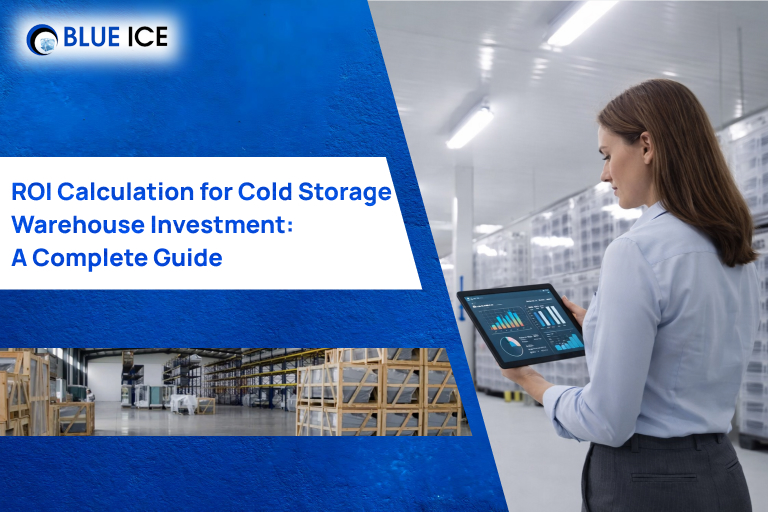
A cold storage warehouse has become the most desirable investment option in India’s agri-logistics and food supply chain ecosystem.
With the increase in demand for fruits, vegetables, dairy, pharmaceuticals, and frozen foods, the cold storage infrastructure is necessitated rather than just enforced.
But determining the ROI for a cold storage warehouse investment is essential for long-term profitability and risk management.
This manual discusses the cold storage condition, investment components, operating costs, revenue models, and the method of accurately calculating ROI for various cold storage projects, including multi-commodity cold storage warehouses.
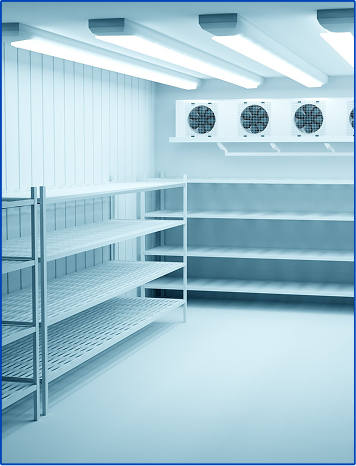
What is cold storage is the first question to expire in the mind of a person hearing the term. A cold storage facility is nothing but a temperature-controlled warehouse that is specially designed to keep perishable products safe by controlling the humidity and temperature at the required levels.
These warehouses do the quality control of the products by stopping the process that makes them bad (spoilage), making them last longer, and maintaining the quality of the products during storage and transportation.
1. Agriculture and horticulture
2. Food processing and fast-moving consumer goods (FMCG)
3. Dairy and meat
4. Pharmaceuticals and vaccines
5. Export-oriented businesses
The demand for cold storage is a very good revenue generation source for a long time because of the constant demand along with a poor organized infrastructure in many areas.
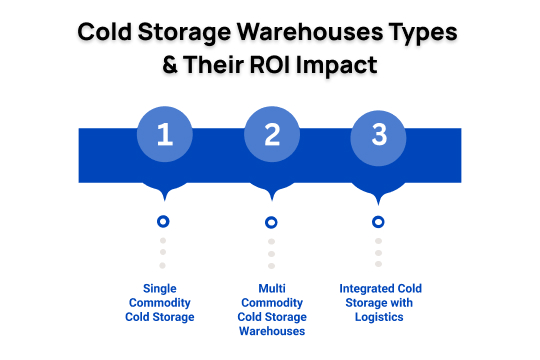
The return on investment (ROI) differs greatly depending on the kind of cold storage that is chosen. The most popular types are:
Mainly used for potatoes, onions, or apples. These types of storage have a stable demand throughout the year with seasonal ups and downs but have low diversification.
These warehouses have separate temperature-controlled zones for storing fruits, vegetables, dairy, frozen food, and pharma products.
The multi-commodity cold storage warehouse is responsible for higher ROI due to the following factors:
Plants connected with ripening chambers, blast freezers, or refrigerated transport give high returns.
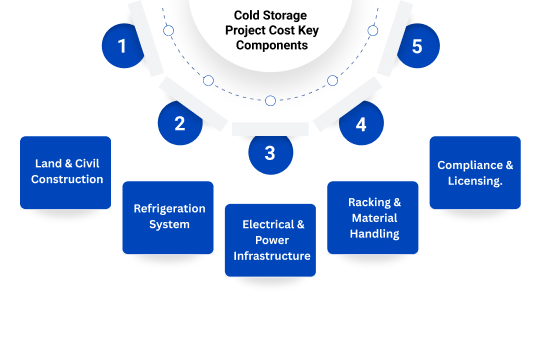
Before going to the ROI calculation, it is necessary to know the cost of the cold storage project. The capital investment depends on the location, capacity, technology, and the level of automation.
The price for land is different for every city and depending on how far away the land is from farms or main roads.
The civil construction consists of insulation panels, flooring, docks, and roofing.
The refrigeration system is the most important part of a cold storage warehouse. The price is determined by:
This includes things like Transformers, Backup generators or solar systems, and Control panels.
Racking and handling of the different materials include Pallet racking and Forklifts and loading equipment.
This includes FSSAI, Fire safety, and Pollution control.
In India, the price of a typical cold storage project ranges from ₹8,000 to ₹15,000 per MT with specifications and region being the determining factors.
Understanding Cold Storage Price and Operating Costs
Despite the fact that project cost is no more than a single investment, ongoing expenses will eat directly into ROI.
The cold storage price in question must be handled in such a way as to avoid losing the business that would otherwise be incurred by non-covering of these expenses, and hence the price must be carefully structured so as to not disturb the profitability.
The amount of money that can be made from a cold storage warehouse will depend on how much of the capacity is used and what services are offered.
The main sources of income are:
Usually, the multi-commodity cold-storage facilities have achieved better revenue stability because of the diversification of their client segment.
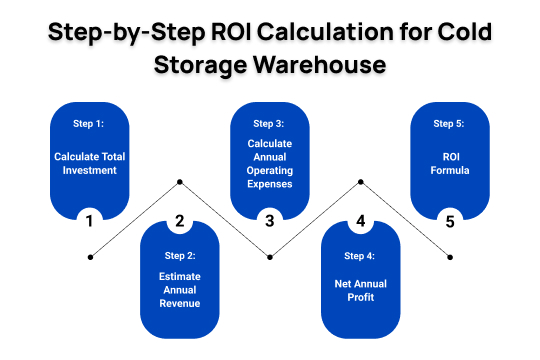
Example:
Cold storage project cost: ₹6 crores
Capacity: 5,000 MT
Let’s assume
Average utilization: 75%
Storage rate: ₹1,200 per MT per month
Annual revenue =
5,000 × 75% × ₹1,200 × 12
= ₹5.4 crore per year
Typical operating cost = 45–55% of revenue
Assume 50%
Annual expenses = ₹2.7 crore
₹5.4 crore – ₹2.7 crore = ₹2.7 crore
ROI (%) = (Annual Net Profit / Total Investment) × 100
ROI = (2.7 / 6) × 100 = 45% per annum
This example shows why a well-managed cold storage warehouse can deliver strong returns.
Factors That Influence ROI in Cold Storage Projects
Proximity to farms, mandis, highways, and ports reduces logistics costs and improves occupancy.
Power-efficient compressors and solar integration can improve margins dramatically.
Higher occupancy equals faster payback.
Pharma and frozen foods generate higher returns than seasonal crops.
Competitive yet profitable pricing ensures long-term client retention.
Government Subsidies and Their Impact on ROI
Government schemes can substantially reduce the cold storage project cost, improving ROI.
Subsidies can reduce initial investment by 20–35%, accelerating break-even timelines.
While ROI potential is strong, risks must be managed:
The cold storage warehouse investment payback period
Cold storage warehouses, when compared to traditional warehousing, yield a higher value through their asset life along with continuous income throughout.
A Blue Ice India cold storage warehouse is an integral part of the overall infrastructure development; it is a strategic asset that contributes to the food security of India and also the efficiency of the supply chain.
Energy-efficient design and diversified commodity handling plus proper planning will yield strong ROI, predictable cash flow, and long-term scalability for investors.
Kalpesh Bhuva, CEO of Blue Ice India, brings over 25 years of expertise in refrigeration and cold chain solutions. He specializes in cold storage, modular cold rooms, multi commodity cold storage, ripening chambers, pharma facilities, and more. His vision focuses on innovation, quality, and advancing sustainable, locally manufactured cold storage technologies across India.

Queries
The cold storage warehouse is a temperature-controlled facility designed to store perishable products such as fruits, vegetables, dairy, pharmaceuticals, and frozen foods by maintaining specific temperature and humidity levels.
Cold storage is a high-ROI investment due to rising demand for perishable goods, limited organized infrastructure, year-round storage needs, and long-term contracts from agriculture, FMCG, and pharma industries.
The average cold storage project cost in India ranges from ₹8,000 to ₹15,000 per metric ton, depending on location, capacity, refrigeration technology, and level of automation.
ROI is calculated using the formula:
ROI (%) = (Annual Net Profit / Total Investment) × 100,
where net profit is derived after subtracting operating expenses from annual revenue.
Major operating costs include electricity consumption, manpower, refrigeration system maintenance, insurance, compliance costs, and repairs, with power expenses accounting for 30–40% of total costs.